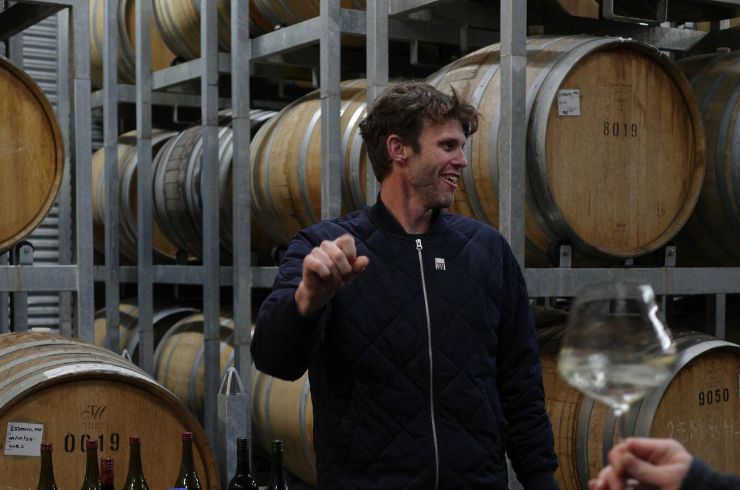
Felton Road winemaker Blair Walter has just put the last of the 2026 wines to barrel. It’s the 30th time he’s done so at the legendary Central Otago winery, which he joined ahead of its first official vintage in late 1996.
It’s a milestone that warrants reflection, especially considering the similarities between the recent ’26 vintage and the inaugural ’97 (both seasons were cool and harvests subsequently late, with fruit near-perfect), which produced a Block 3 that Robert Parker declared was a dead-ringer for grand cru Burgundy.
The story begins in 1990, when founder Stewart Elms decided, at 50-something, to give up his blackcurrant farming business and pursue his dream to make great pinot noir. In 1992, after graduating from Lincoln University, he bought a block of land on Felton Road, and on a north-facing valley cut into the Bannockburn hills, began planting the Elms vineyard.

Stewart sold the winery in 2000 to UK-expat Nigel Greening, who shared a similar ambition and had already acquired the nearby Cornish Point apricot orchard for his own pinot project. Blair stayed on as winemaker, and with Nigel, has continued to build on Felton Road’s reputation as both a regional pioneer and benchmark pinot noir producer.
Today, Felton Road has 34ha under vine (of which 75 per cent is pinot noir, and the rest chardonnay and riesling) across four sites: Elms, Cornish Point, MacMuir and Calvert – the latter two were officially purchased in 2010 and 2013 respectively, although both farmed by the winery since 2001. From this fruit, six pinot noirs, three chardonnays and three rieslings are produced.
Because site expression is paramount, winemaking is kept simple, the fruit vinified in much the same way – wild fermentation, around 25 per cent whole bunch, moderately long time on skins, no fining, filtration, or cold stabiliation, etc. “It’s a pretty boring place to work,” Blair jokes.

“We want Cornish Point to taste like Cornish Point. We want Calvert to taste like Calvert,” he adds. “Inevitably, winemaking becomes very simple, very transparent. There’s no diversity or no single technique that's allocated to this vineyard or that vineyard. It's a very straight up approach.”
That doesn’t mean the wines don’t have a stamp. “There’s definitely a house style,” Blair says. “There's a deliciousness and drinkability to our wines, a silkiness and approachability, although they also enjoy spending time in the cellar.
“One of the biggest compliments that I can get as a winemaker is when somebody tells me that they instantly recognised a Felton Road. To me that's really important, because if I think about the great wines of the world that I love to drink, that's one of the defining characters.”

Felton Road is also known for its sustainability leadership. As well as managing the estate biodynamically since 2002 (certified since 2010), and investing in low-impact technology such as drones, one of their more notable practices is the long-term use of lightweight bottles, now down to just 390g.
“It used to be an absolute no-no for premium wine brands to use lightweight bottles, but we've always been fully committed to being as sustainable as we possibly can,” Blair says.
“We’re committed to our sites and the pursuit of quality, and we’re not distracted by a need to increase production or introduce a second label. We’ve always just been focused on producing the best wines that we can off our estate.”
Sign up to view these tasting notes and ratings
By becoming a member of Wine Companion, you'll have access to the largest database of wines in Australia.
Expand your knowledge with Halliday Wine Academy
Halliday Wine Academy offers an in-depth view of both Australian and international wine landscapes. Select Introduction to Wine to learn about Australian wine and regions or choose from one of our Wines of the World courses to get to know international wines.
Wines of the World: Europe explores the iconic wines, regions and laws of France, Spain, Portugal, Hungary, Germany and Austria, while Wines of the World: Europe and Beyond delves deeper into Italy, Greece, the Americas, South Africa and New Zealand.